If you’re a mother, sister, or daughter in a family affected by Lowe syndrome, you may be wondering whether you carry the gene change that causes it. That’s exactly what this page is here to help with — a clear look at how carrier detection works, so you and your doctor or genetic counselor can decide what’s right for your family.
Lowe syndrome is caused by a change in the OCRL gene (oculocerebrorenal syndrome of Lowe), located on the X chromosome. Because males have only one X chromosome, a change in that single copy of the gene is enough to cause Lowe syndrome. Females have two X chromosomes, so a healthy copy on the second X usually compensates — which is why most carriers don’t have symptoms themselves, but can pass the gene change on to their children.
It’s Common to Have No Family History
Some mothers of boys with Lowe syndrome are carriers who inherited the gene change from their own mother, or who are the first carrier in the family. But many are not carriers at all — the gene change can also arise spontaneously (called a de novo mutation) in the egg or early in the pregnancy, with no prior family history at all. Neither outcome is more or less common than the other in the way people sometimes assume, and a mother’s carrier status says nothing about anything she did or didn’t do.
This is exactly what carrier testing is designed to sort out — and it’s worth knowing going in that a negative result is a completely normal, common outcome, not a sign that something else is wrong.
How We Determine Carrier Status
Carriers don’t show outward symptoms, so carrier status can’t be confirmed just by looking or by using the enzyme test that diagnoses an affected male child. Instead, we rely on two tools — often used together — to determine whether someone carries the Lowe syndrome gene change.
Carrier Detection Flowchart
The flowchart depicts the usual steps taken to determine whether someone is a Lowe syndrome carrier. Without a doubt, the ophthalmologic examination is the easiest to perform, although it cannot be used until a person nears the age of puberty.


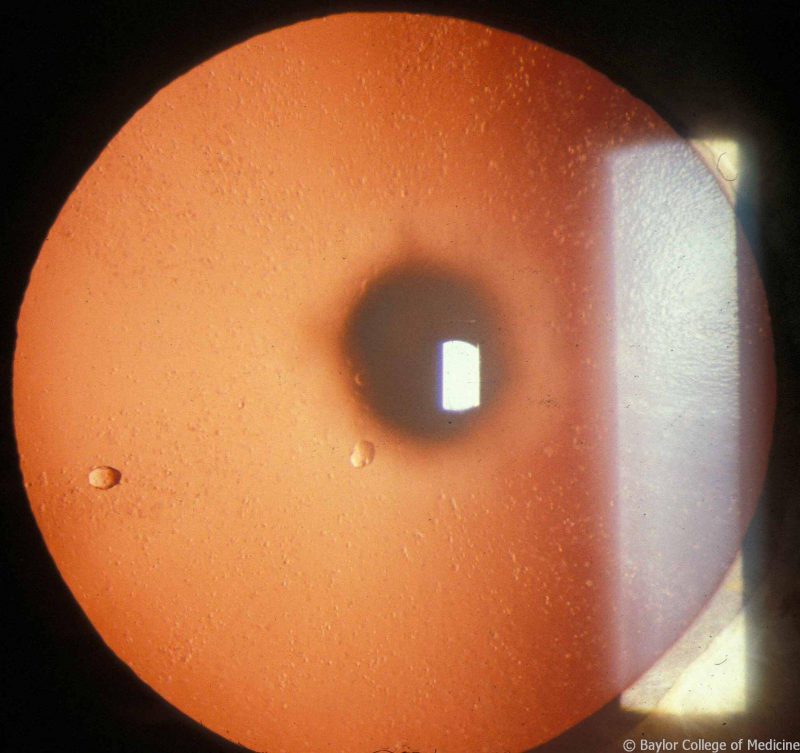

These slides have been graciously provided by Dr. Richard A. Lewis, M.D. of the Baylor College of Medicine. For more information, please contact Dr. Lewis at the following address. Copyright Baylor College of Medicine.
Richard A. Lewis, M.D.
Cullen Eye Institute NC-206
Baylor College of Medicine
1 Baylor Plaza
Houston, TX 77030
Can a Female Have Lowe Syndrome?
Yes — though it’s very rare. The explanation involves some technical genetics, so if you’re not looking for that level of detail right now, feel free to skip to the next section. If you’re curious, or your genetic counselor has mentioned one of these terms, here’s what’s going on.
Every cell in a female’s body randomly switches off one of her two X chromosomes early in development, so on average about half her cells use one X and half use the other. In rare cases, this process skews so heavily that nearly all of a carrier’s cells end up using the X chromosome that carries the Lowe syndrome gene change — with no healthy copy active to compensate. When that happens, the female can have Lowe syndrome herself.
This is an even rarer event where a piece of the X chromosome and a piece of another chromosome (an autosome) break and swap places — a “balanced translocation.” Normally, this doesn’t cause problems, because all the genetic material is still present. But if the swap happens to break the X chromosome inside the OCRL gene itself, and that particular X chromosome is the one that stays active, the female will have only the altered copy of the gene working in her cells — and will have Lowe syndrome, just as a boy would.
Carrier testing is a personal decision, and you don’t have to sort through it alone.
Find a genetics lab near you and start the conversation with your doctor or a genetic counselor. Want to hear from someone who’s been through it? Connect with an LSA family peer who can walk you through what testing was like for their family.